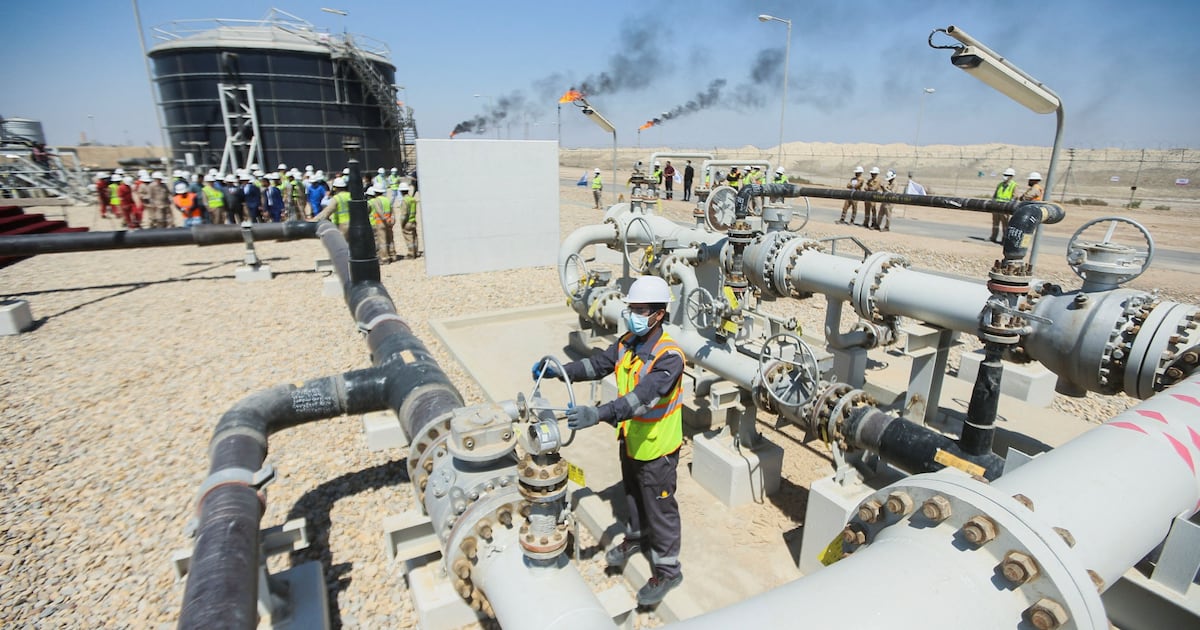

The recent inauguration of Iraq’s Basra-Haditha oil pipeline, with a 2.5 million bpd capacity, marks a pivotal shift in the Middle East and North Africa’s energy infrastructure landscape. As the region’s OPEC second-largest producer, Iraq’s strategic pivot to bypass the Persian Gulf—Snowed with tensions since the Iran conflict—underscores its resilience amid Hormuz disruptions. Directing crude to Syria’s Baniyas, Turkey’s Ceyhan, and Jordan’s Aqaba, the pipeline not only secures export routes but integrates southern, central, and northern refining hubs, fostering domestic industrial synergy. This infrastructure move aligns with Iraq’s urgent need to stabilize output, as pre-war averages of 3.4 million bpd have plummeted, necessitating alternative pathways to preserve market share and revenue.
The project, slated to commence exports after final inspections, requires $1.5 billion in state-backed funding, sourced through Iraq’s Ministry of Oil and Ministry of Industry and Minerals. Domestic pipe manufacturing, a condition of the project’s contractual framework, highlights a dual mandate: economic localization and fiscal prudence amid constrained global capital flows. While the timeline remains contingent on additional budget approvals—a nod to Baghdad’s financial constraints—the initiative reflects a sovereign commitment to prioritizing energy security over external dependencies. Comparatively, Saudi Arabia’s East-West pipeline and the UAE’s Habshan-Fujairah route exemplify a regional trend of state-led infrastructure investment to circumvent geopolitical bottlenecks, reinforcing MENA’s self-reliant energy narratives.
The pipeline’s ripple effects extend beyond Iraq’s borders, influencing MENA’s broader infrastructure competition. For instance, Turkey’s Ceyhan terminal now handles increased Iraqi flows, while Syria’s involvement in facilitating transit—despite its own geopolitical instability—signals a recalibration of trust dynamics among non-Arab Gulf actors. Such cross-border logistics networks amplify vulnerability to regional instability yet offer opportunities for collaborative frameworks, potentially attracting sovereign-backed venture capital to stabilize and scale critical projects. Private equity, however, remains cautious; the high-risk profile of Middle Eastern infrastructure investments—exacerbated by conflict spillovers and regulatory volatility—limits direct VC engagement, even as state actors pressure for localized technical expertise to mitigate execution risks.
Ultimately, Iraq’s pipeline underscores a MENA-wide recalibration of energy sovereignty, where sovereign capital and state priorities redefine investment landscapes. While venture capitalists remain sidelined by sector-specific risks, the pipeline’s success could catalyze hybrid models—state-backed guarantees paired with targeted private partnerships—to de-risk complex projects. This evolution may gradually incentivize VC interest in ancillary technologies, such as pipeline monitoring or alternative transport systems, though execution hinges on sustained geopolitical stability. For now, the Basra-Haditha project epitomizes a top-down strategy to insulate regional energy output from external shocks, cementing infrastructure as a linchpin of MENA’s economic recalibration.