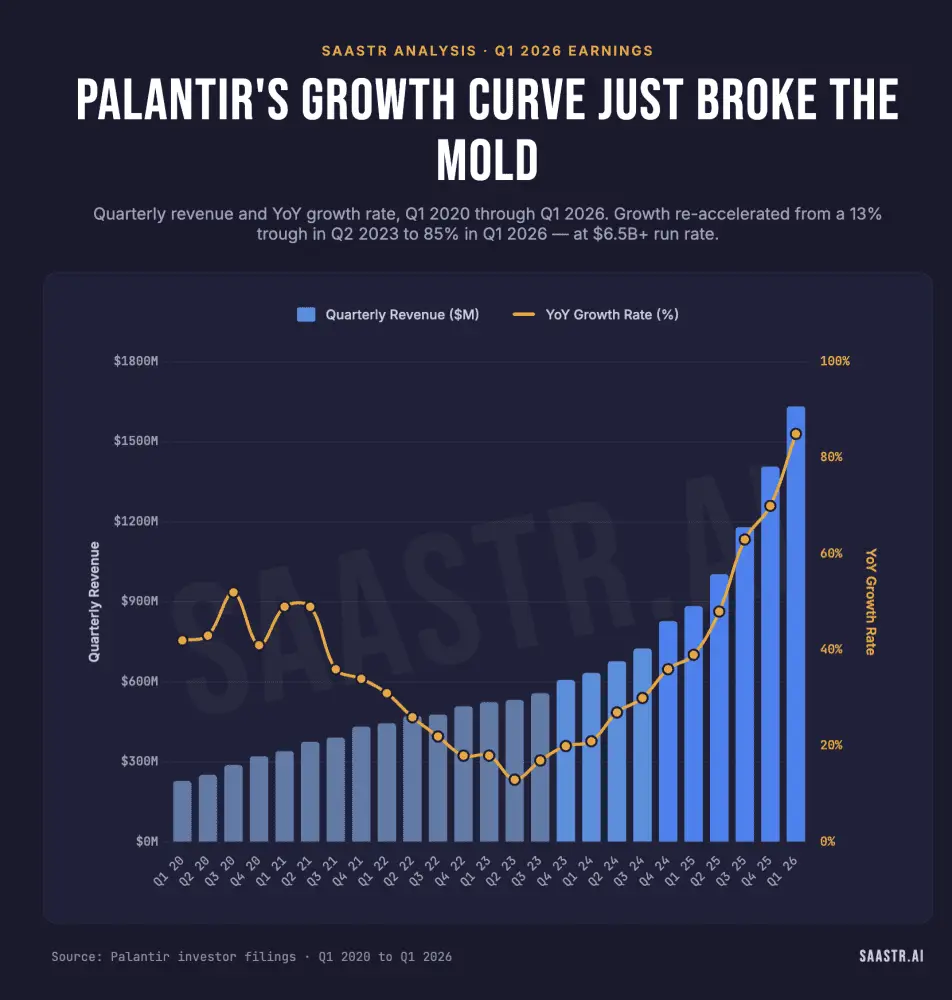

Palantir Technologies’ Q1 2026 results defy conventional enterprise software growth paradigms, delivering an 85% year-over-year revenue surge to $1.633 billion and a $6.5B+ run rate, while achieving adjusted operating margins of 60% and an annualized revenue per employee of $1.5 million. This trajectory—combining hypergrowth with profitability rarely seen in mature software firms—reflects a structural shift in how AI-native platforms are reshaping global enterprise dynamics. For the Middle East and North Africa (MENA), this signals a critical inflection point: sovereign wealth funds and venture capitalists in the region must reassess risk/reward frameworks for tech investments, as Palantir’s playbook challenges the assumption that scalability demands deceleration. The company’s ability to monetize AI workflows at scale, particularly in legacy-heavy sectors like defense, energy, and industrial logistics—which align closely with MENA’s economic pillars—could catalyze similar ventures locally, provided regional policymakers prioritize sovereign capital allocation toward AI infrastructure and digital sovereignty.
The divergence between Palantir’s commercial momentum and its traditional government roots underscores a broader MENA-imperative. While the U.S. commercial business grew 133% YoY to $595 million, absorbing 56% of Q1 2026 revenue—surpassing government contracts for the first time—this shift mirrors MENA’s own strategic pivot toward private-sector-driven economic transformation. Countries like Saudi Arabia and the UAE, which have prioritized Vision 2030 and UAE Centenary 2071 agendas to diversify economies, must now accelerate investments in sovereign-backed AI infrastructure to compete globally. Palantir’s $4.45B Q1 RPO—up 134% YoY—and its $7.66B FY2026 guide, which doubled its Q1 performance, reveal a funding trajectory that sovereign wealth funds could emulate by targeting AI equity stakes, infrastructure-as-a-service platforms, or defense-technology partnerships with the same scale and urgency. The regional playbook will hinge on aligning public capital with venture-scale private innovation, echoing Palantir’s $8B cash position and debt-free balance sheet, which now sets the gold standard for tech unicorns.
For MENA venture ecosystems, Palantir’s performance reframes the calculus of risk versus reward. At $1.5 million revenue per employee—tripling historical benchmarks for mature SaaS firms—the company operationalizes a post-blitzscaling model where AI-driven efficiency negates traditional headcount expansion. This challenges MENA startups to adopt AI-native architectures from inception or face dislocation, particularly in fintech, smart cities, and energy tech—sectors ripe for disruption akin to Palantir’s defense and commercial verticals. Moreover, the 71% YoY FY2026 revenue guide and $2.41B Q1 TCV (transactional contract value) highlight the pricing power of “platform shift” software, which MENA investors must now prioritize over legacy metrics like gross margins. As sovereign capital floods into AI and cloud infrastructure, the region’s venture arms risk obsolescence unless they replicate Palantir’s playbook: scaling RPO growth faster than revenue, targeting Fortune 500s in production environments, and deploying AI agents as operational multipliers rather than lab experiments.