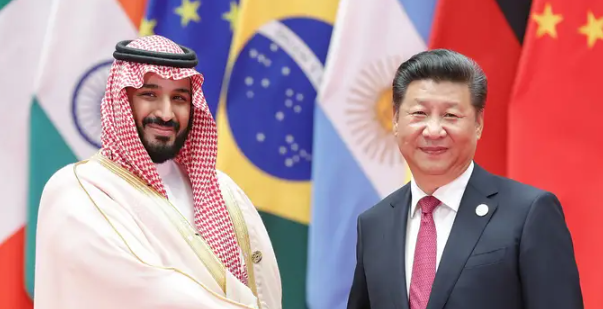

Public Investment Fund (PIF), the Saudi Arabian sovereign wealth fund managing approximately $1 trillion in assets and the largest such vehicle in the Middle East and North Africa, has launched a second mainland China office, a strategic expansion that accelerates the region’s reorientation of sovereign capital toward Asian markets. The move signals a deepening institutional commitment to China’s domestic financial ecosystem, moving beyond historical energy-linked trade ties to direct exposure to Chinese technology, artificial intelligence, renewable energy and digital infrastructure sectors that are critical to MENA’s collective economic diversification mandates. This is not a bilateral Saudi-China play alone: it sets a benchmark for peer Gulf sovereign wealth funds including ADIA, QIA and Mubadala, which are increasingly prioritising on-ground Asian presence to capture deal flow outside traditional Western financial hubs.
The expansion will reshape MENA’s venture capital and infrastructure financing landscapes by unlocking direct access to China’s $300bn+ domestic VC ecosystem, which dominates early-stage funding for semiconductors, AI and green tech. For MENA sovereigns, this bypasses restrictive Western regulatory barriers on Gulf capital investing in cutting-edge technology, while enabling co-investment structures that lower risk for regional allocations to emerging industries. On the infrastructure front, PIF’s deeper China ties align with overlapping Belt and Road Initiative and GCC regional development plans, including NEOM, the GCC rail network and North Africa’s renewable energy corridors, creating cross-regional financing vehicles that can deploy capital across both markets at scale. MENA-based startups in fintech, logistics and climate tech will also gain indirect access to Chinese supply chains and growth capital, accelerating the maturation of the region’s nascent tech hubs in Riyadh, Dubai and Cairo.
PIF’s move reflects a structural shift in global sovereign capital allocation, as MENA funds increasingly prioritise direct Asian exposure to hedge against volatility in traditional Atlantic markets and Western regulatory constraints on technology investments. For the broader MENA region, this reduces overreliance on energy export revenues, while building a coordinated regional investment bloc that can negotiate preferential terms for technology transfer and infrastructure partnerships. The second China office also strengthens Riyadh’s role as a regional financial hub, as smaller MENA sovereigns and institutional investors are likely to channel Asian exposures through PIF’s on-ground infrastructure, deepening financial integration across the Arab world. This reallocation of sovereign capital will have lasting implications for global tech and infrastructure markets, with MENA’s combined $4 trillion in SWF assets increasingly acting as a bridge between Asian production capacity and growth markets in Africa and Southern Europe.