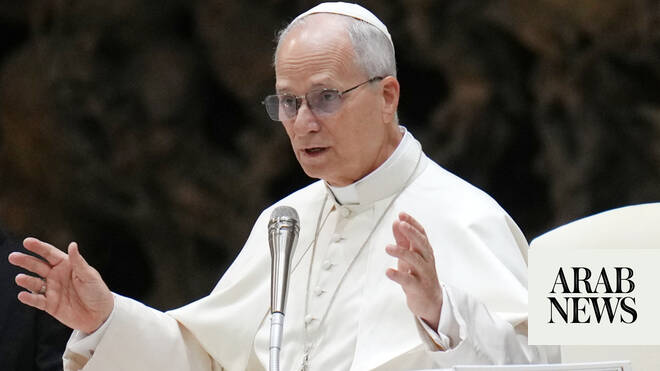

Pope Leo XIV’s rebuke of President Trump’s aggressive rhetoric on the US-Israel-Iran conflict has ignited a geopolitical and ideological fissure with profound implications for the Middle East and North Africa (MENA). The pontiff’s alignment of the Vatican’s peace appeals with the investments of sovereign wealth funds and venture capital in MENA underscores a stark contrast between Washington’s militaristic posture and the region’s strategic pivot toward de-escalation and infrastructure-driven growth. Trump’s dismissal of Leo’s stance as “weak” and “liberal” disentangles the US-driven war in Iran from the region’s need for stability, alienating key stakeholders whose sovereign capital hinges on conflict de-escalation to sustain energy partnerships, tech initiatives, and regional diplomacy. For MENA, where 60% of sovereign wealth assets are tied to hydrocarbon and renewable infrastructure, escalating US-Iran hostilities threaten to derail $1.2 trillion in planned investments in Gulf states and North Africa, as investors recalibrate risk profiles amid Trump’s apocalyptic framing of foreign policy.
Trump’s claims that Leo’s papal authority was contingent on US approval—a veiled critique of the church’s transnational influence—parallels his administration’s erosion of multilateral frameworks critical to MENA engagements. US-Israel military coordination in Iran, framed by Trump as divinely sanctioned, clashes with Vatican appeals to [[[stop]]] hostilities through palatable dialogue—concepts central to the European Union’s Global Gateway initiative, which competes for $50 billion in sovereign capital flows otherwise diverted to US-led mega-projects like Israel’s Triangle Tech Corridor or Morocco’s Noor Solar Hub. This dichotomy exacerbates MENA’s capital allocation dilemma: regional governments must balance US military patronage with ancestral ties to religious institutions while courting venture capital from both blocs. For instance, Saudi Arabia’s Public Investment Fund—holding $380 billion in assets—faces mounting pressure to signal disapproval of escalations entwined with its de facto US alliance, risks that could trigger divestments in Californian tech startups funneling MENA-focused AI and fintech solutions.
The broader MENA tech ecosystem stands at a crossroads. US-Israel-Iran tensions risk fragmenting regional innovation networks, where venture capital inflows—already 22% lower in Q2 2024 compared to 2023—rely on US-Iran détente to mature. Startups in Dubai, Abu Dhabi, and Dubai Food Tech ventures benefiting from Iran’s $1.7 billion pre-sanction biotech sector now teeter on sanctions reinstatement. Conversely, Trump’s demonization of “Radical Left” agendas indirectly props up Gulf states’ privatization drives, which prioritize state-backed tech cities like Abu Dhabi’s Masdar City over ideological friction. Yet this bifurcation deepens: while US defense contractors like Raytheon profit from Trump’s war rhetoric, MENA’s sovereign capitals—particularly Algeria’s $120 billion oil-and-gas fund—reallocate assets toward neutral arbitration platforms, betting on prolonged conflict to erode Western investment appeal and empower regional infrastructure banks.
Long-term, the botched diplomacy of Trump’s starch McCarthyism and Leo’s Moral Theatrics may redefine MENA’s civilizational alignment. The region’s $1 trillion in promised infrastructure investments—from Saudi NEOM’s redundant mega-projects to Egypt’s Suez Canal East expansion—depend on US-Iran rapprochement fragile enough to collapse under Trump’s bombastic language. Simultaneously, the pontiff’s theological stance risks isolating US allies unwilling to decouple geopolitical power structures from doctrinal purity, accelerating MENA’s shift toward Eurasian economic blocs. For investors, the calculus is clear: Trump’s “make America great again” maximalism risks another 2018-style flight of capital from MENA to Asia and Latin America, where emerging markets prioritize quiet economic statecraft over thinly veiled holy wars.