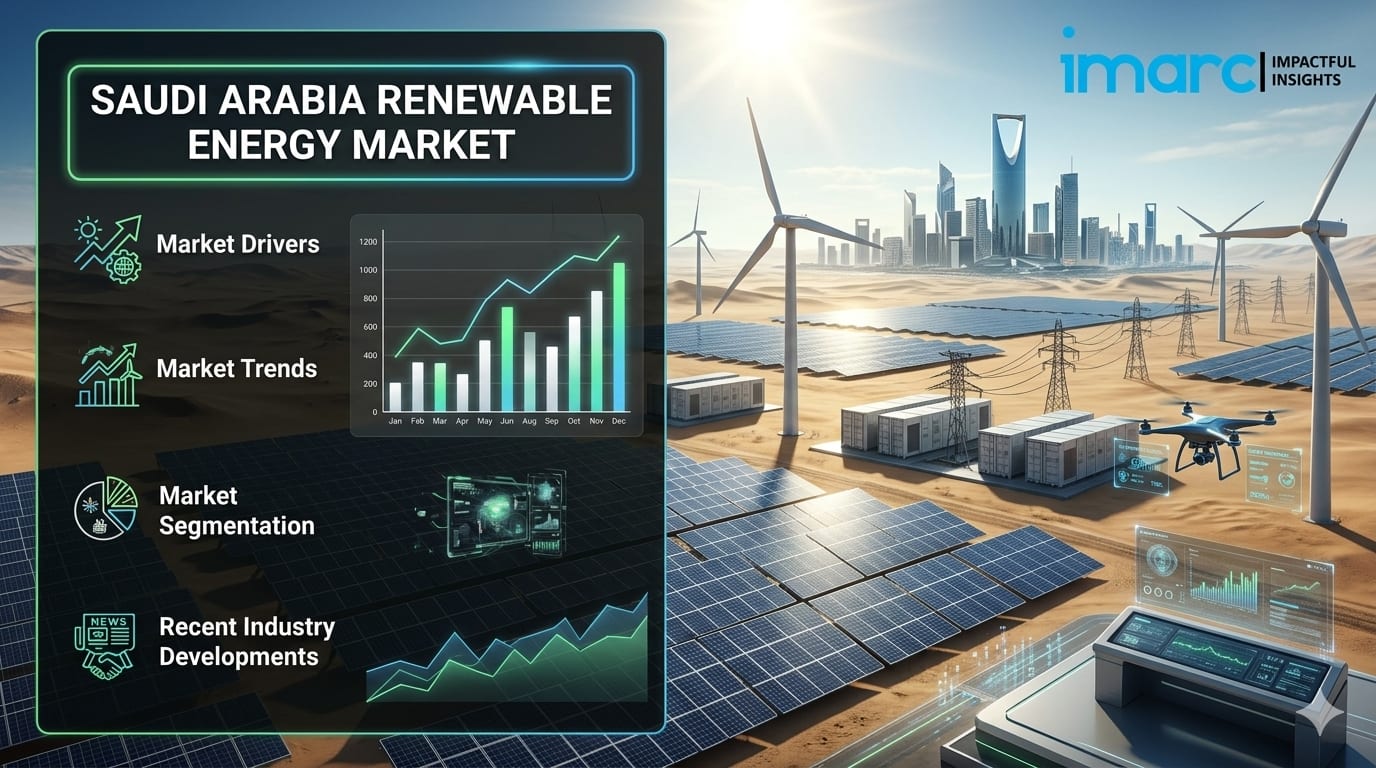

The Middle East and North Africa’s financial and technology sectors stand at a critical juncture as the region pursues transformative energy transitions. Saudi Arabia, in particular, is spearheading an ambitious overhaul of its energy portfolio, leveraging its vast solar potential to position itself as a regional and global renewable capital. With Vision 2030 as its strategic backbone, the Kingdom has initiated expansive clean energy programs attracting substantial sovereign capital and ambitious venture capital commitments. The financial architecture underpinning this shift is increasingly robust, with market reports projecting the renewable energy landscape in Saudi Arabia to surgest from 2.84 gigawatts in 2025 to an impressive 40.83 gigawatts by 2034—a compound annual growth rate of 34.46% between 2026 and 2034.
This surge is not merely quantitative but deeply rooted in structural reforms that elevate the regulatory certainty and investment readiness of the entire ecosystem. The implementation of rigorous competitive bidding frameworks, extensive power purchase agreements, and clearly delineated localization mandates are establishing a stable, scalable framework for both regional and international stakeholders. These mechanisms have catalyzed a wave of large-scale solar project launches, with five new projects turning operational in the annum alone, adding over 3,750 megawatts of capacity and bolstering Saudi solar’s dominance at 93%. The institutionalization of these processes has reduced investment risks, sharpened pricing efficiency, and strengthened the financial narrative for a sector poised for exponential growth.
Beyond solar, the market is witnessing considerable momentum in the regional infrastructure evolution for integrated clean energy solutions. Solar remains the linchpin, but a nascent green hydrogen value chain is emerging in tandem, exemplified by the NEOM Green Hydrogen Company’s groundbreaking Oxagon facility. This venture not only enhances renewable portfolio diversity but also lays the foundation for high-value exports to Europe and Asia, aligning Saudi Arabia’s ambitions with the broader global decarbonization agenda. Simultaneously, the accelerating rollout of utility-scale solar and storage systems—including the deployment of a 7.8 gigawatt-hour battery energy storage project—demonstrates the Kingdom’s pivot from renewable generation to a more resilient, integrated clean power system.
For investors and financial institutions, these developments are reshaping risk profiles, project timelines, and export-ready value chains. Regional integration is no longer on the periphery, but its centrality to the region’s financial and energy future has never been more pronounced. The convergence of policy, capital, technology, and infrastructure in this dynamic market underscores a pivotal era in the MENA financial landscape—a transformation that will define wealth, resilience, and impact for years to come.