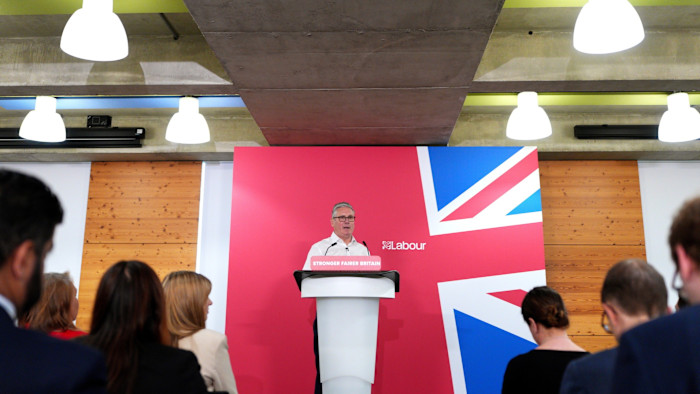

Sir Keir Starmer’s address to Labour backbenchers on Monday was, by any institutional measure, a non-event — a speech calibrated for survival rather than direction, one that confirmed what sovereign wealth fund managers and regional capital allocators have quietly priced in over the past fortnight: the United Kingdom’s political centre of gravity is shifting faster than its fiscal or strategic frameworks can absorb. For the Gulf Cooperation Council states, whose combined sovereign assets exceed $4 trillion and whose London-based investment vehicles constitute a critical corridor for European real estate, infrastructure debt, and technology exposure, the absence of a credible leadership pivot in Westminster is not merely a domestic irritant. It is a signal that the UK’s capacity to act as a reliable counterweight to the dollarized petro-state model is deteriorating, and that capital will flow toward jurisdictions offering strategic clarity — Dubai, Riyadh, and increasingly Abu Dhabi — rather than toward Westminster’s ambiguity.
The broader implication for MENA venture capital and regional infrastructure is more acute. UK-based fintech, climate-tech, and AI firms that have relied on post-Brexit London as a gateway to European institutional capital now face a compounding risk: political paralysis in the UK is eroding the credibility of pound-denominated fundraising cycles, and the absence of a coherent fiscal or regulatory roadmap from No. 10 is accelerating the rerouting of European expansion capital through Gulf financial hubs. Abu Dhabi’s Mubadala and Saudi Arabia’s Public Investment Fund have spent the better part of two years diversifying their European allocations; Starmer’s inability to articulate a credible economic narrative beyond performative redoubling of commitments only validates their cautious posture. The regional infrastructure pipeline — from NEOM’s data centre corridors to Egypt’s sovereign-backed renewable energy mandates — was never contingent on UK domestic politics, but the narrative environment matters when sovereign capital allocators benchmark political risk alongside credit risk.
What Labour’s internal crisis underscores for the MENA analyst is the structural fragility of Western institutional credibility in a world where the Gulf states are building parallel systems of governance, capital formation, and technology deployment at pace. The bond market anxiety that Starmer’s would-be successors are generating is not an abstraction — it is the same volatility that regional sovereign funds monitor when rebalancing exposure to Western debt instruments. The fundamental calculation remains unchanged: the UK is entering a period of strategic drift, and for a region that has spent two decades converting hydrocarbon surplus into diversified capital infrastructure, that drift is an invitation to accelerate the geographic diversification of ambition. The blow could fall on Starmer today or in three months. For MENA capital, the timeline is irrelevant. The repositioning is already underway.