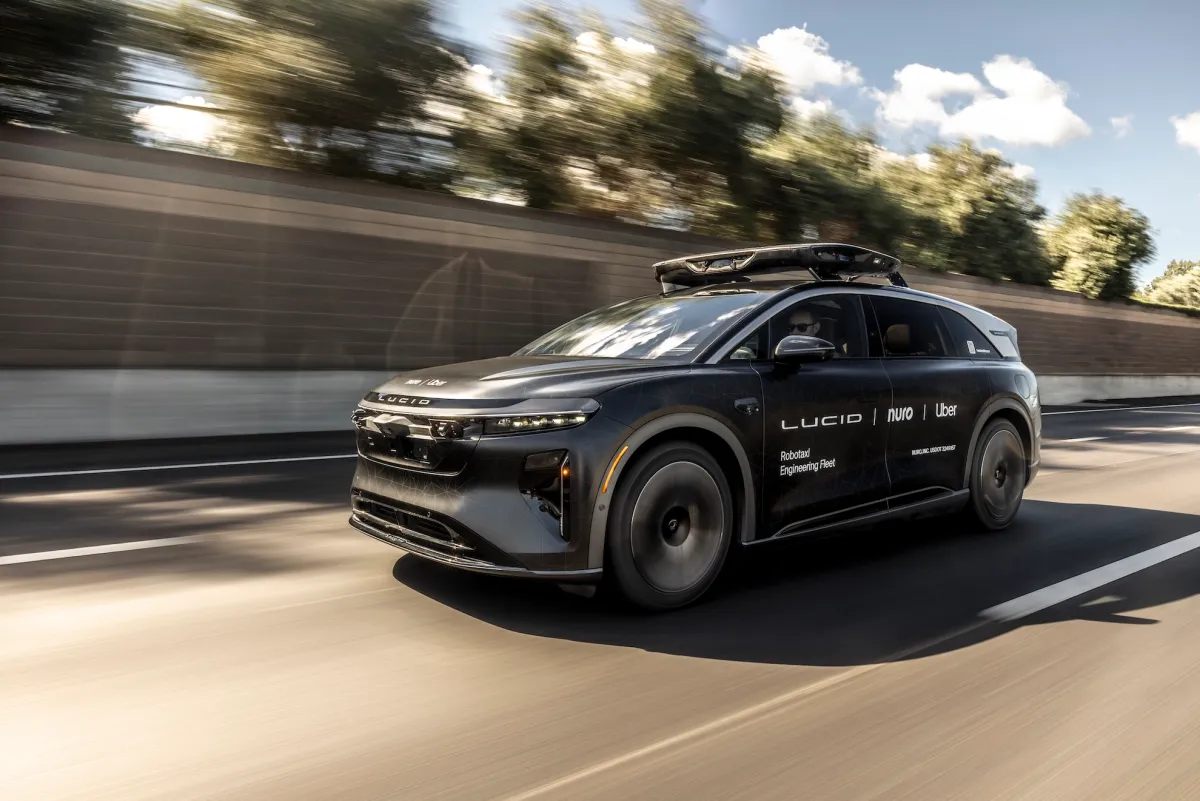

The latest development in autonomous mobility has profound implications for the evolution of urban transportation frameworks, particularly within high-growth markets. Uber’s rollout of employee-exclusive test rides using the Nuro-equipped Lucid Gravity SUV, now available in San Francisco through the Uber app, marks a significant milestone in the trajectory towards scalable robotaxi deployment. This phase of controlled testing allows for refinement of operational parameters within real-world urban environments, reinforcing the precision required for large-scale, system-wide autonomous mobility solutions. Such early-stage deployments also lay critical groundwork for data accumulation and safety validation—both of which are significant precursors for regulatory approvals necessary to shift from test phases to a fully operational public launch expected later in the year.
At the economic and strategic center of this advancement is the multi-stakeholder investment architecture underpinning the initiative. Uber’s $300 million infusion into Lucid, coupled with its contractual commitment to deploy at least 20,000 Lucid Gravity SUVs over six years, represents a deliberate capital concentration toward maximizing asset utility and operational leverage in the premium mobility segment. This strategic anchoring is further reinforced by Nuro’s undisclosed but substantial investment from Uber, earmarked to optimize the AV system powered by Nvidia’s Drive AGX Thor computing platform. The scale of capital deployment here speaks to the macroeconomic intent: consolidating technical interoperability and manufacturing capacity in aim of unseating legacy transportation propositions with technologically superior alternatives.
From a Middle East and North Africa (MENA) vantage point, this evolution foretells both opportunity and imperative. The region’s sovereign wealth funds, increasingly active in strategic technology acquisitions, may view the seedbed of scalable autonomous mobility as a timely investment frontier. Urban centers in Gulf Cooperation Council countries exhibit the dense, highly planned environments conducive to robotaxi operability. Furthermore, the alignment of such ventures with regional goals of urban megaproject innovation, such as Saudi Arabia’s NEOM and Qatar’s Lusail City, suggests relevance for foreign direct investment and partnership alignment. For local sovereign entities, positioning capital in early-stage partnerships or regional strategic alliances could yield technological transfer advantages and spur indigenous expertise development in the autonomous transport sector. As foundational testing and logistics integrations proceed in Western markets, MENA stakeholders have a narrowing window to calibrate sovereign capital allocation and infrastructure planning to synchronize with this anticipated transformation in mobility.