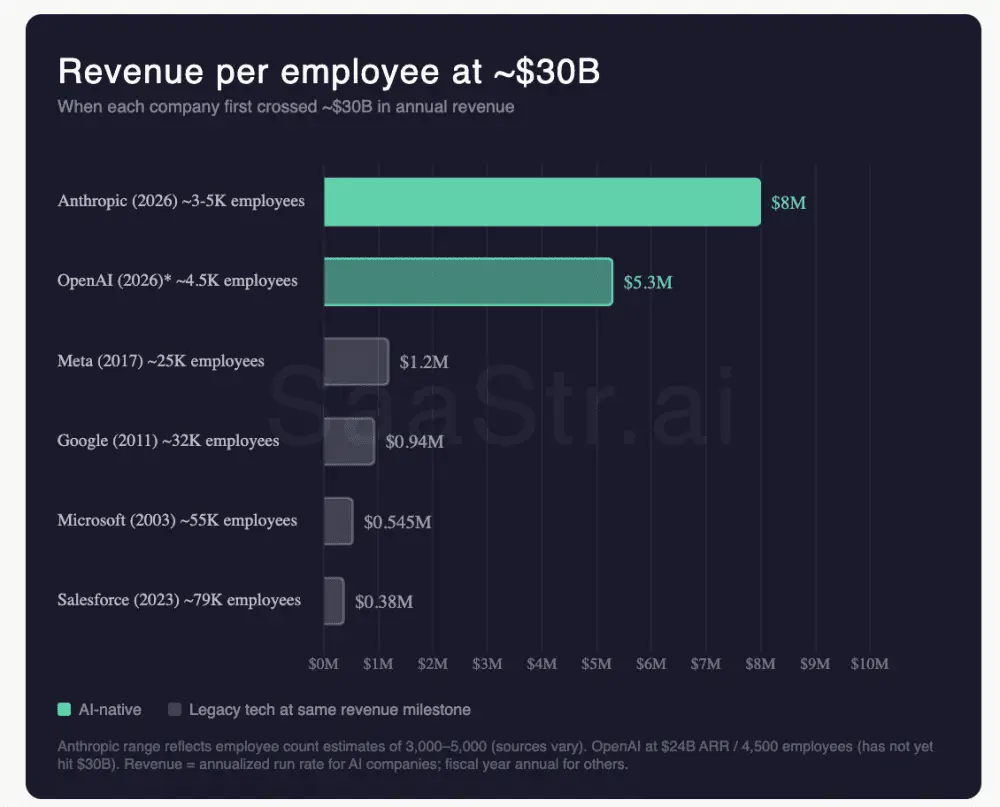

Anthropic’s surge to $30 billion in annualised revenue—reached in the first quarter of 2026—represents a watershed for the emerging AI ecosystem in the Middle East and North Africa. The firm’s 15‑month, 30‑fold revenue expansion, from a $1 billion run‑rate at the end of 2024 to $30 billion by March 2026, far outstrips the growth curves of legacy tech giants and sets an unprecedented benchmark for capital efficiency. For sovereign wealth funds and regional development banks, the implication is clear: AI‑driven enterprises can now deliver megascale returns with a headcount footprint an order of magnitude smaller than that required by traditional software behemoths, thereby reducing the risk premium on venture and growth‑stage financing.
Equally striking is Anthropic’s revenue‑per‑employee metric, which towers at six to ten times the level recorded by Google at a comparable scale and 15‑25 times that of Salesforce. With an estimated workforce of 3 000‑5 000 engineers and operators, the company has shown that high‑value AI services—particularly in enterprise coding and co‑development—can be scaled without the massive payroll burdens that have historically constrained regional tech hubs. This model aligns with the strategic objectives of MENA sovereign investors, who are increasingly allocating capital toward lean, compute‑intensive platforms that promise rapid margin expansion as fixed‑cost compute infrastructure amortises over soaring top‑line growth.
The operational discipline underpinning Anthropic’s performance—rigorous focus on a narrow set of use cases, avoidance of costly multimodal expansions, and a modest 1.5‑2 GW compute footprint—offers a template for regional AI start‑ups seeking to attract both private venture capital and state‑backed funding. By demonstrating that inference costs can be slashed by 90 % year‑over‑year, the firm validates the business case for local data‑center development, renewable‑energy‑backed compute clusters, and the creation of AI‑focused talent pipelines across the Gulf, Levant, and Maghreb. Such infrastructure investments, already earmarked in several sovereign AI strategies, stand to benefit from the economies of scale that Anthropic’s trajectory illustrates.
In practical terms, the Anthropic story reshapes the calculus for MENA’s next wave of AI ventures. Venture capitalists are likely to prioritize companies that can replicate the ‘lean AI’ model—high revenue per employee, deep vertical specialization, and a fixed‑cost compute base—over those pursuing broad, hardware‑heavy ambitions. For sovereign wealth entities, the lesson is twofold: allocate a larger share of capital to AI firms that can deliver outsized revenue with limited staff, and concurrently invest in the supporting ecosystem—high‑efficiency compute, regulatory sandboxes, and specialised training programs—to capture the upside of a sector that is proving capable of generating multi‑billion‑dollar returns in under a decade.