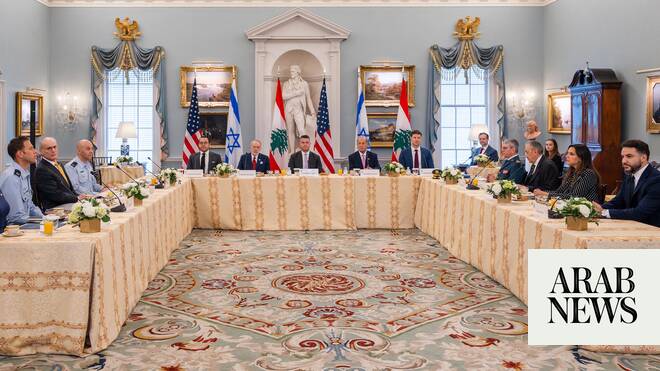

The 45-day extension of the Israel-Lebanon ceasefire, brokered by Washington, represents a pivotal de-risking event for the Levant corridor, with immediate implications for sovereign capital deployment and venture investment in the region. The cessation of hostilities alleviates a significant geopolitical risk premium that had been embedded in Lebanese asset valuations and deterred foreign direct investment. For international capital, particularly from Gulf Cooperation Council (GCC) sovereign wealth funds and pan-regional private equity, the sustained calm provides a critical window to reassess exposure to Lebanon’s distressed but potentially high-yield sectors, including financial services restructuring, real estate redevelopment, and maritime logistics at Beirut’s port. The involvement of high-level security officials signals a shift from purely political dialogue to tangible confidence-building measures, which is a prerequisite for unlocking the $3 billion in pledged but dormant IMF-linked reforms and associated multilateral financing.
This diplomatic momentum directly impacts venture capital and technology infrastructure strategies across the Middle East. A stable Lebanon could re-integrate its highly educated diaspora and nascent fintech/startup ecosystem into regional value chains, creating arbitrage opportunities for investors seeking undervalued tech talent and early-stage ventures. Furthermore, the security track announced for the Pentagon underscores a US strategic intent to formalize cross-border security coordination, which is essential for any future large-scale energy or digital infrastructure projects. Such projects—from the Arab Gas Pipeline interconnection to fiber-optic data corridors linking the Gulf to Europe via Israel and Lebanon—have been stalled by conflict. The ceasefire extension therefore serves as a catalyst for re-evaluating the viability of these multi-billion-dollar regional integration projects, potentially attracting engineering and construction firms and infrastructure investors eyeing long-term concession agreements.
For Lebanon, the talks are a litmus test for state sovereignty and institutional credibility, factors that directly determine the cost and availability of sovereign capital. The Lebanese delegation’s emphasis on restoring state authority across all territory is a coded acknowledgment that lasting peace is a prerequisite for unlocking external budget support and accessing international capital markets. Failure to translate this ceasefire into a durable political agreement will perpetuate capital flight and maintain Lebanon’s isolation from global financial systems. Conversely, a successful track could pave the way for a structured debt renegotiation and renewed engagement with institutions like the World Bank, redirecting development finance towards critical infrastructure—water, power, and digital—that underpins private-sector growth. The regional implication is a potential recalibration of risk for investors who have long viewed the Levant as a binary bet on conflict resolution versus perpetual instability.
In the broader MENA context, this US-facilitated process highlights a strategic pivot where geopolitical stabilization is increasingly a precondition for economic integration. The involvement of security officials at the Pentagon suggests a move towards institutionalized, rather than ad hoc, security guarantees, which could lower the perceived risk for long-term infrastructure financing. For the Gulf, a peaceful Levant reduces the threat of spillover conflict and opens a land bridge for trade and investment, aligning with Saudi Vision 2030 and UAE diversification goals. Ultimately, the extension is not merely a pause in fighting but a potential inflection point where capital begins to price in the removal of existential tail risks, shifting capital allocation models from crisis response to strategic, long-horizon investment in the region’s human and physical infrastructure.