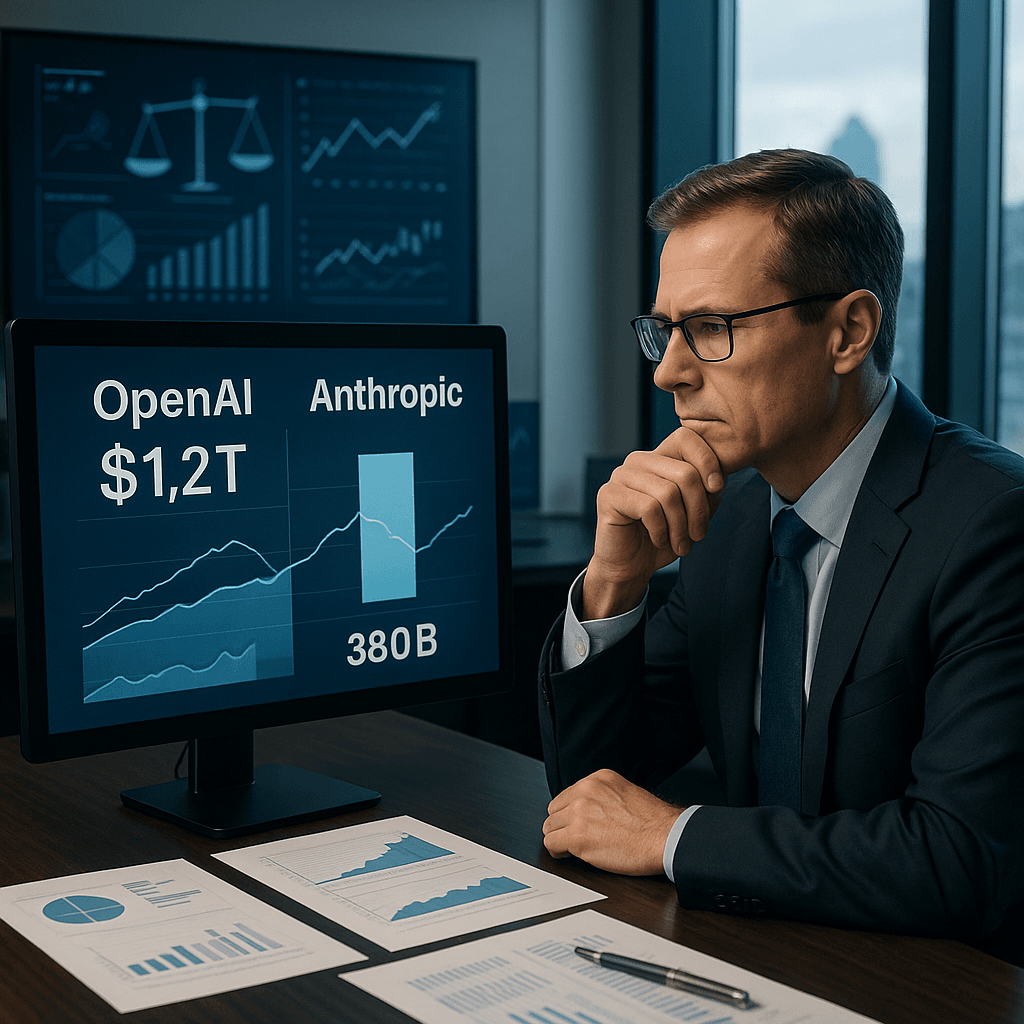

The recent recalibration of investor expectations surrounding OpenAI and Anthropic carries profound implications for Middle Eastern and North African sovereign wealth funds and institutional allocators that have increasingly earmarked capital for frontier AI exposures. OpenAI’s latest funding round, which necessitates a $1.2 trillion IPO valuation to justify returns, stands in stark contrast to Anthropic’s more modest $380 billion pricing—a disparity that has prompted GCC-based investors such as the Public Investment Fund, Mubadala, and the Qatar Investment Authority to reassess the risk‑adjusted returns of their AI portfolios. The shift underscores a growing preference among these entities for valuations anchored in demonstrable enterprise adoption and AI safety frameworks, rather than purely speculative consumer‑facing growth trajectories.
For venture capital firms active across the Levant and North Africa, the valuation gap is prompting a strategic pivot toward later‑stage, B2B‑oriented AI ventures that mirror Anthropic’s emphasis on constitutional AI and enterprise partnerships. Funds such as BECO Capital, Wamda Ventures, and Endure Capital are re‑evaluating deal pipelines to prioritize startups offering clear pathways to revenue generation through regulated sectors—finance, healthcare, and energy—where the cost of AI failure carries significant reputational and regulatory penalties. This reallocation is expected to accelerate the formation of specialized AI‑focused funds within the region, leveraging existing sovereign‑backed fund‑of‑funds structures to deploy capital more efficiently.
From an infrastructure perspective, the evolving sentiment reinforces the business case for targeted investments in AI‑ready data centers and compute hubs that cater to safety‑compliant model training and inference. Sovereign‑backed initiatives such as Saudi Arabia’s Neom, the UAE’s Mohammed bin Rashid Innovation Fund, and Egypt’s Technology Innovation and Entrepreneurship Center are likely to prioritize partnerships with AI providers offering verifiable governance controls, thereby aligning capital expenditure with the emerging preference for lower‑risk, high‑utility AI stacks. Consequently, the regional AI ecosystem may witness a consolidation of demand around platforms that balance performance with regulatory resilience, shaping the next wave of public‑private partnerships that underpin MENA’s digital transformation agenda.