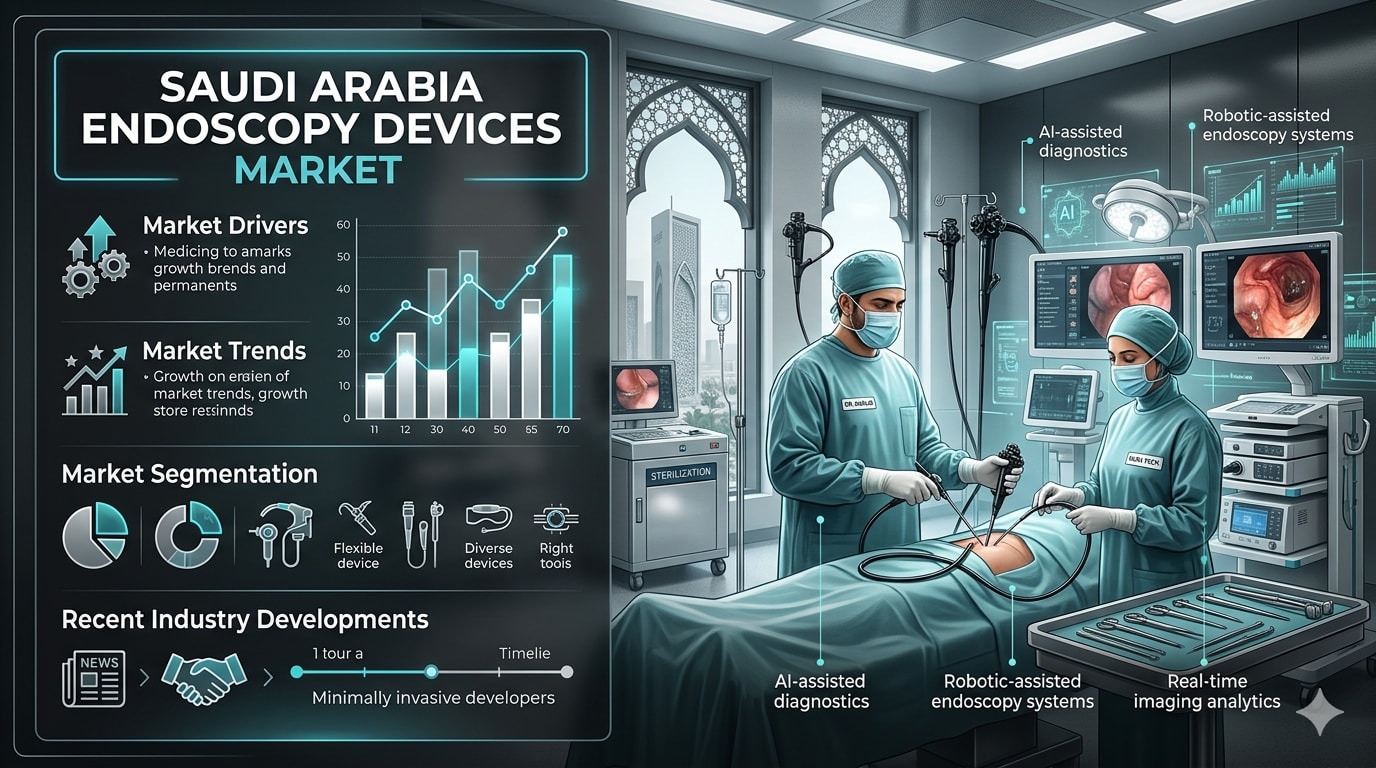

Saudi Arabia’s endoscopy devices market, projected to triple from USD 497.5 million in 2025 to USD 903 million by 2034 (6.85% CAGR), reflects a strategic convergence of public health priorities and private sector capital infusion. The sector’s expansion is structurally tied to Vision 2030’s healthcare modernization agenda, which aims to elevate private healthcare expenditure from 25% to 35% of total spending, creating a fiscal environment primed for large-scale medical technology adoption. Government investments, exceeding USD 50 billion in digital health initiatives alone, are catalyzing demand for advanced endoscopic systems—particularly in gastroenterology, where late-stage colorectal cancer diagnoses (nearly one-third of cases) underscore the urgency for AI-enhanced screening solutions. This policy-driven demand is reshaping regional healthcare infrastructure, with centralized hubs like Riyadh’s Northern and Central Region emerging as high-tech nexuses supported by regulatory consolidation and hospital networks.
Venture capital and sovereign institutional frameworks are increasingly intersecting in this ecosystem. The National Industrial Development and Logistics Program’s push to localize medical device production—evident in Fujifilm Middle East’s MoUs to foster local partnerships and build service centers—highlights efforts to reduce import dependency while building strategic supply chain resilience. Such moves align with global capital trends: firms like Medtronic are acquiring regional players (e.g., Fortimedix Surgical) to tap into Saudi Arabia’s $12 billion healthcare market, where AI integration in endoscopy workflows is accelerating. Simultaneously, sovereign-backed initiatives, such as the Saudi Fund for Development’s healthcare infrastructure bonds, are de-risking private equity participation, enabling firms like Waycen to deploy AI-driven diagnostic tools (e.g., the WAYMED Endo platform) at scale. This capital duality is fostering a hybrid model of public-sector policy backing and venture-driven innovation.
Medical tourism in the Western Region—particularly in Jeddah and Makkah—adds another layer of business imperatives, compelling hospitals to adopt premium diagnostic equipment to meet global quality benchmarks. The adoption of 4K endoscopic systems by private facilities and Saudi Arabia’s bid to curb outbound medical tourism are fueling demand for high-definition visualization and robotic-assisted platforms. Regionally, Eastern and Southern provinces are emerging as secondary growth corridors, supported by government-funded hospital upgrades and mobile endoscopy expansion targeting rural populations. These developments are not isolated; they are part of a broader institutional strategy to transform the Kingdom into a regional healthcare innovation hub, with endoscopy devices serving as both a diagnostic cornerstone and a gateway to broader digital health adoption.