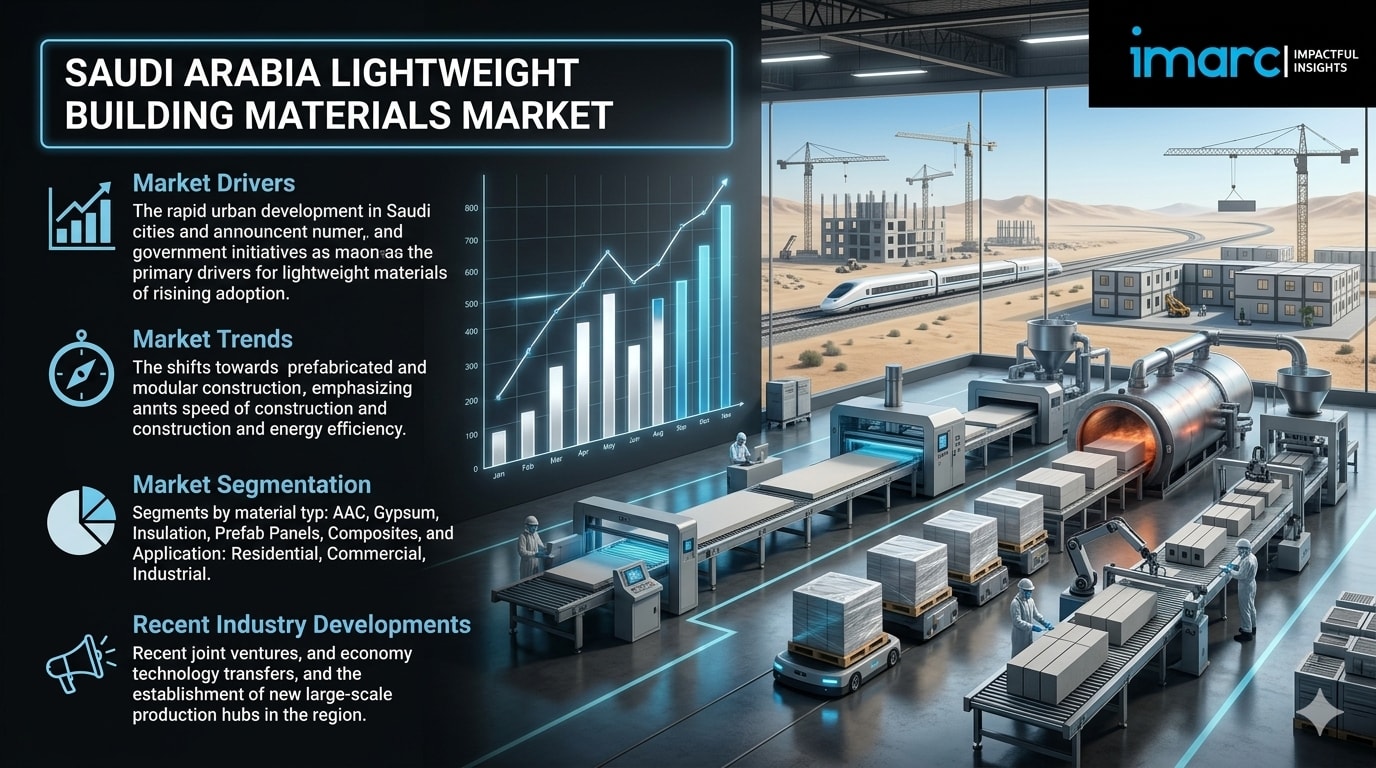

Saudi Arabia’s lightweight building materials market, a critical component of Vision 2030’s economic diversification strategy, is undergoing transformative growth driven by sovereign capital mobilization and strategic infrastructure investments. The government’s USD 1.3 trillion Vision 2030 pipeline, encompassing 18,000+ projects across real estate, transportation, and megaprojects like NEOM, is catalyzing demand for materials that enable rapid, sustainable construction. The Kingdom’s push for energy-efficient infrastructure, supported by green building mandates such as the Ministry of Municipalities and Housing’s Building Sustainability Assessment System, which evaluated 85+ million square meters of projects in 2024 alone, underscores the structural shift toward lightweight concrete (34% market share) and eco-panels. This institutional focus aligns with global ESG trends while positioning Saudi Arabia as a regional hub for high-performance construction, attracting sovereign-backed equity that extends beyond domestic borders through cross-border supply chain partnerships.
Venture capital dynamics are increasingly shaping the sector, with foreign investment minting domestic manufacturing ecosystems. Samsung C&T’s SAR 1.3 billion investment in Riyadh-based robotics-driven construction automation exemplifies how global players are partnering with Saudi firms like Asas Al-Mohileb to localize production of lightweight materials, such as calcined clay substitutes for traditional cement. These alliances—combined with Owens Corning’s expanded insulation manufacturing and Saint-Gobain’s introduction of fiber-reinforced polymer systems—reflect a surge in private sector participation targeting the market’s USD 5.3 billion 2034 projection. Such capital influxes are accelerating pre-fabrication adoption, with developers prioritizing factory-produced components to meet Vision 2030’s aggressive timelines, while startups leveraging AI-powered quality tracking tools are optimizing resource allocation across 3,800+ annual construction permits issued.
Regionally, Saudi advancements serve as a blueprint for MENA infrastructure modernization, with implications extending beyond national borders. The Red Sea Development and Qiddiya projects’ adoption of lightweight materials for thermal efficiency and carbon footprint reduction could galvanize regional regulatory harmonization on sustainability standards. Cross-border tech transfer, evidenced by China Harbour Engineering’s Riyadh modular facility, is likely to spur similar investments in neighboring economies seeking to diversify away from hydrocarbon dependence. Furthermore, Saudi Arabia’s role as the world’s largest crude oil producer positions it to influence regional energy efficiency narratives, with lightweight insulation systems emerging as de facto solutions for meeting cooling demands in hotter microclimates—a trend poised to reshape regional urban planning paradigms.
Business models in the sector are evolving toward circular economy principles, with lightweight materials acting as linchpins for decarbonization. The 3.08% CAGR from 2026–2034, driven by population growth to 38 million, signals sustained demand across residential and commercial segments, particularly in high-rise urban centers like Riyadh and Jeddah. As municipalities tie financing approvals to material certifications—75% of projects assessed in 2024—builders are accelerating adoption of composite materials that balance speed, durability, and compliance. This convergence of sovereign ambition, foreign capital, and technological pragmatism not only reshapes Saudi construction but establishes a replicable MENA blueprint for future-proofing infrastructure in climate-constrained environments.