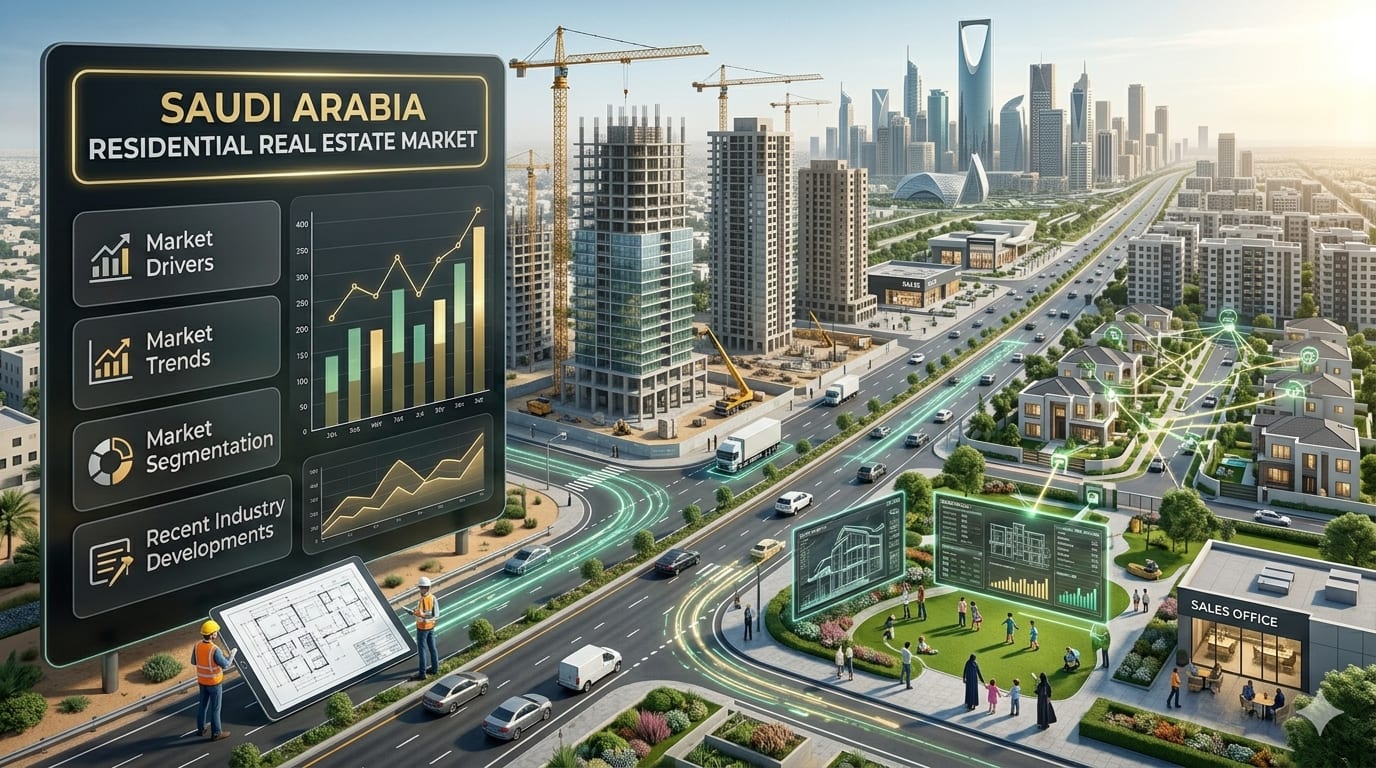

Saudi Arabia’s residential real estate market, now valued at roughly USD 76.8 billion in 2025 and projected to surpass USD 141.6 billion by 2034, is being propelled by an unprecedented confluence of sovereign policy, demographic momentum, and influxes of foreign capital. Vision 2030’s explicit mandate to deliver 500,000 new housing units, coupled with over 15 regulatory reforms and a SAR 650 billion pipeline of mortgage financing, has de‑risked demand elasticity and unlocked private‑sector participation at scale.
Rapid urbanisation—85 % of the population already resides in urban centres—creates acute pressure for integrated, high‑quality housing. State‑backed megaprojects such as Banan City, slated to accommodate 120,000 residents through 20,000 smart homes, exemplify how sovereign investment in urban infrastructure is directly translating into a pipeline of mixed‑use developments that blend residential, commercial, and civic functions.
Venture capital and strategic foreign partnerships are injecting fresh dynamics into the sector. Recent US‑Saudi memoranda of understanding with globally experienced developers bring benchmark construction standards, accelerate delivery schedules, and elevate product quality, while the new regulatory framework permitting non‑Saudis to own property in designated zones expands the investor base and stimulates cross‑border capital flows.
The ripple effects extend across the broader MENA region, establishing Saudi Arabia as a bellwether for sovereign‑driven real estate transformation. As large‑scale financing mechanisms, smart‑city technologies, and mixed‑use frameworks mature, they are shaping regional investment blueprints, encouraging neighboring governments to adopt comparable policy levers and infrastructure financing models that will redefine the architecture of growth throughout the Middle East and North Africa.